

Walk-Behind vs Riding Lawn Mower: Which Type Fits Commercial and Residential Mowing Operations?
September 23, 2026
For most commercial and residential mowing operations, the choice between a walk-behind and riding lawn mower depends on property size, terrain, mowing frequency, labor requirements, and transport needs. Walk-behind machines provide tighter control around obstacles and work well on smaller or more detailed areas. Riding machines cover larger properties faster and reduce operator walking time. For B2B buyers, the decision should focus on total operating requirements rather than purchase price alone.
A landscaping contractor working across residential properties may need different equipment from a grounds maintenance company serving large commercial sites. A walk-behind mower can handle narrow gates, garden sections, slopes, and landscaped areas with frequent obstacles. A riding machine becomes more practical when the mowing area expands and productivity becomes the main concern.
The same distinction applies to distributors and equipment dealers. A suitable lawn mower range should cover the applications of the target market rather than rely on one machine type. Product selection should consider cutting width, power source, deck configuration, transmission, operator controls, maintenance access, and expected duty cycle.
For companies sourcing equipment from a manufacturer, understanding these differences also helps determine which models belong in a commercial portfolio and which models suit residential lawn mowing. The right product mix can reduce specification mismatches and make purchasing decisions more consistent.
How Do Walk-Behind and Riding Lawn Mowers Differ in Daily Operation?
The most obvious difference is the operator position. A walk-behind mower requires the operator to move behind or alongside the machine. A riding mower places the operator on the machine and uses a seat-mounted control system.
That difference affects productivity, maneuverability, storage, and labor requirements. Neither configuration works best for every property.
Walk-Behind Mowers for Controlled and Detailed Cutting
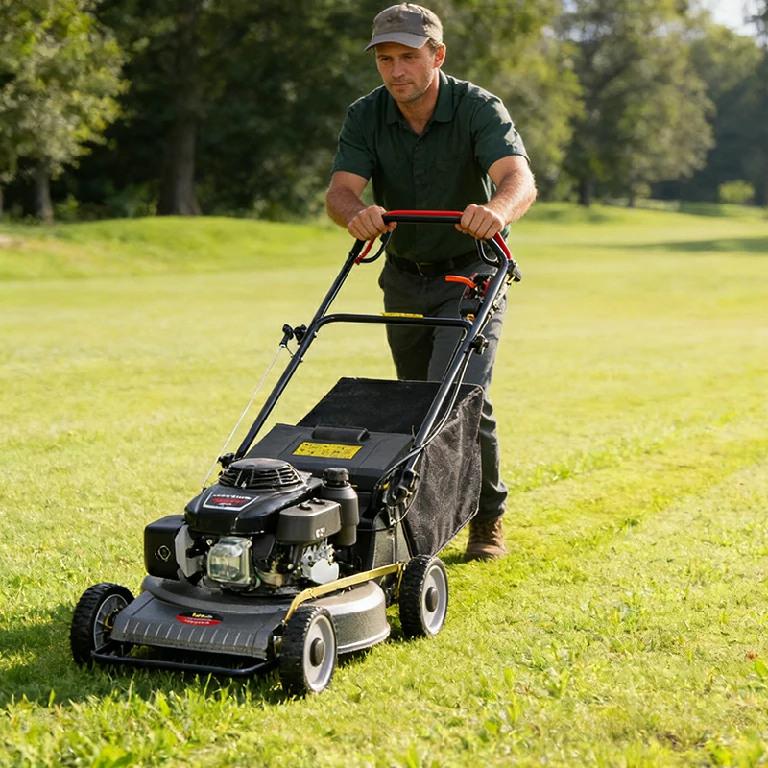
Walk Behind Lawn Mowers are generally suited to areas where maneuverability matters more than maximum coverage. Operators can move around trees, flower beds, pathways, fences, and other landscape features with relatively direct control.
A walk-behind design can also simplify access to properties with narrow entrances. This matters for residential contractors who work in older neighborhoods or properties with restricted access.
Commercial operators may use walk-behind units for trimming areas that larger machines cannot reach. Sports grounds, public landscaping, hotels, schools, and residential communities can all contain sections that require close control.
The main trade-off is labor. The operator must walk throughout the mowing process, which can increase physical demand over long shifts.
Riding Mowers for Larger Mowing Areas
A riding lawn mower allows the operator to remain seated while covering a larger area. The machine carries its own weight and usually provides a wider cutting deck than many walk-behind models.
This configuration becomes more useful as property size increases. Large lawns, parks, estates, commercial grounds, and institutional properties can require extensive mowing time. A wider deck can reduce the number of passes required across an open area.
Riding equipment also changes the labor equation. One operator can cover a substantial area without walking behind the machine for the entire shift.
However, larger dimensions can limit access. Gates, narrow paths, landscaping features, and tight corners may require another machine for finishing work.

Which Mower Type Fits Different B2B Applications?
Application requirements should come before machine specifications. A distributor may receive inquiries for both residential and commercial applications, while a landscaping contractor may need several machine types within one fleet.
The useful question is not simply which mower is larger. It is which configuration creates the best balance between coverage, maneuverability, labor, and maintenance for a specific operating environment.
Residential Lawn Mowing
Residential properties often contain multiple obstacles. Trees, fences, flower beds, driveways, pathways, and garden structures can divide the mowing area into smaller sections.
Walk-behind machines can provide useful control in these environments. They also require less storage space and can move through narrower access points.
For larger residential lots, a riding mower may become more practical. The decision depends on lawn area and layout rather than the residential label alone.
A contractor serving a mixed customer base may therefore carry both configurations. Walk-behind machines can handle detailed areas, while riding units can cover larger open lawns.
Commercial Landscaping
Commercial landscaping creates different operating priorities. Contractors often manage multiple properties during the same working day, so productivity and equipment utilization become important.
A commercial lawn mower used for regular service needs to match the expected duty cycle. Cutting width, engine output, deck construction, transmission, service access, and operator ergonomics can affect daily operation.
Large open properties often favor riding equipment. Smaller commercial sites may still favor walk-behind machines when access and maneuverability dominate.
Parks, Schools, and Institutional Grounds
Institutional grounds can combine open turf with trees, pathways, buildings, and landscaped areas. A single machine may not handle every section efficiently.
Open fields can support riding mower use. Narrow areas around buildings may require walk-behind equipment.
Fleet managers should therefore evaluate the site as a collection of mowing zones. Matching each zone with the appropriate mower can improve equipment utilization without forcing one machine to perform every task.
Rental and Dealer Markets
Rental companies and outdoor power equipment dealers face another consideration. Equipment must serve a broad range of customers.
A rental fleet may need machines for homeowners, property managers, landscaping contractors, and grounds crews. Product durability and ease of operation become important because operators may have different experience levels.
Dealers also need clear product segmentation. Customers should be able to understand the intended application without comparing dozens of technical specifications.
Table: Application Comparison for Walk-Behind and Riding Mowers
| Application | Walk-Behind Mower | Riding Mower |
|---|---|---|
| Small residential lawns | Strong fit | May be unnecessary |
| Large residential properties | Suitable for detailed areas | Strong fit for open areas |
| Narrow access points | Strong fit | Limited by machine dimensions |
| Landscaping around obstacles | Strong fit | Requires additional maneuvering |
| Large commercial lawns | Suitable for finishing work | Strong fit |
| Parks and open grounds | Suitable for smaller sections | Strong fit |
| Mixed terrain | Depends on model | Depends on model and stability |
| Rental fleets | Easy to position for smaller jobs | Useful for larger properties |
| Long daily mowing shifts | Higher operator walking demand | Lower walking demand |
| Detailed trimming zones | Strong fit | May require supplemental equipment |
What Technical Factors Should Buyers Compare?
Machine configuration has a direct effect on operating performance. Buyers should evaluate specifications as a complete system rather than selecting a mower from one headline number.
Cutting Width and Productivity
Cutting width determines how much turf the machine can cover in one pass. A wider deck can reduce the number of passes across open ground.
That advantage has limits. Wider equipment may have difficulty passing through narrow gates or working between landscape features.
For a distributor, offering several cutting widths can provide better market coverage. Contractors can then select machines according to site conditions rather than compromise on access.
Engine and Powertrain
Engine output should correspond with deck size, grass conditions, terrain, and expected workload. A larger deck may require more power to maintain cutting performance under demanding conditions.
The powertrain also matters for riding machines. Transmission design, drive configuration, speed control, and serviceability can affect daily operation.
For walk-behind equipment, drive assistance can reduce operator effort on slopes and larger lawns. Self-propelled configurations can be particularly relevant for professional users.
Cutting Deck and Discharge Configuration
The deck influences cutting consistency, grass handling, cleaning requirements, and maintenance.
Side discharge can support fast mowing in suitable open areas. Mulching configurations return finely cut grass to the lawn. Collection systems can be useful where grass clippings must be removed.
A commercial buyer should consider which cutting method matches the end user’s maintenance practices.
Controls and Operator Ergonomics
Operator controls become increasingly important when equipment runs for several hours each day.
Handle height, control layout, vibration, seat position, steering effort, pedal arrangement, and visibility can influence operator fatigue and productivity.
These factors may receive less attention during a basic product comparison. For commercial users, however, they can affect equipment acceptance and long-term utilization.
Maintenance Access
Routine maintenance should not require unnecessary disassembly. Air filters, oil systems, belts, blades, battery compartments, grease points, and other service components should remain reasonably accessible.
Dealers should also consider the availability of replacement parts and service procedures. A mower with straightforward maintenance can reduce downtime across a working fleet.
For manufacturers and distributors, these details deserve inclusion in product documentation. Technical buyers often need more than engine displacement and cutting width before placing a bulk order.
Contact Xinghu to discuss lawn mower specifications, model selection, and B2B supply requirements.
How Should Buyers Evaluate Commercial Mower Economics?
Purchase price is only one part of mower economics. A commercial fleet should be evaluated through operating hours, maintenance requirements, fuel or electricity consumption, labor input, downtime, and expected service life.
A lower purchase price does not automatically produce a lower operating cost. The machine may require more frequent maintenance or may not match the workload.
Labor and Coverage
Labor can become a major cost when mowing large areas. A riding machine may reduce walking time and increase the amount of turf covered during each working shift.
Walk-behind equipment can still provide better economics for smaller or fragmented properties. Using a larger riding unit where access is poor can create wasted movement and additional finishing work.
The best comparison therefore uses actual mowing conditions. Estimate the area covered per hour, then account for turns, obstacles, loading, unloading, and transport between properties.
Maintenance and Downtime
Maintenance costs depend on the mower design, engine, cutting system, operating hours, and service schedule.
Commercial users should review service intervals before purchasing. Parts availability also matters when a fleet operates on tight schedules.
A mower that remains unavailable for several days can affect the contractor’s schedule. Dealer support and spare parts planning should therefore form part of the purchasing process.
Transport and Storage
Fleet operators need to consider how machines move between job sites. Trailer dimensions, machine weight, loading height, and storage footprint can influence logistics.
Walk-behind units generally require less transport space. Riding equipment may require larger trailers or more structured fleet planning.
Storage also affects dealers and rental businesses. Floor space, maintenance areas, and seasonal inventory can influence the practical cost of carrying each product category.
Fuel, Battery, and Emissions Considerations
Power source has become an increasingly important purchasing factor. Gasoline remains common in outdoor power equipment, while battery-powered options continue to expand across lawn and garden applications.
EPA regulates emissions from small spark-ignition engines used in lawn and garden equipment. Its regulations address exhaust and evaporative emissions from these engines. (EPA)
For commercial buyers, power source selection should consider operating hours, charging infrastructure, refueling practices, noise requirements, local regulations, and service capabilities.
The right choice can vary significantly by market. A distributor serving different regions should verify applicable local requirements before selecting engine or powertrain configurations.
Which Mower Should a Distributor or Contractor Add to a Fleet?
A fleet does not necessarily need to choose between walk-behind and riding equipment. In many commercial applications, the two configurations complement each other.
A riding mower can cover open turf efficiently. A walk-behind machine can handle narrow spaces, detailed areas, and locations that restrict access.
The most practical fleet strategy often starts with the work profile.
Build the Fleet Around Property Types
A contractor serving mainly small residential properties may need a larger proportion of walk-behind machines. Companies managing parks or large commercial grounds may require more riding equipment.
Mixed portfolios need a combination.
The important variables include:
- Average property size
- Average mowing frequency
- Access width
- Terrain and slope conditions
- Number of obstacles
- Daily operating hours
- Transport distance
- Available storage
- Service and maintenance capacity
These variables provide a more useful purchasing framework than choosing a mower based only on engine size or deck width.
Match Product Range to Customer Segments
Manufacturers and distributors should also separate models by customer use.
Residential users may prioritize ease of operation, storage, and purchase cost. Commercial contractors often focus on productivity, durability, service access, and operating economics.
Rental companies may need simple controls and robust construction. Property managers may prioritize reliability and consistent cutting performance.
A product catalog should communicate these differences clearly. This approach helps sales teams recommend the right configuration without relying on broad claims.
Consider the Long-Term Supply Relationship
For B2B purchasing, product selection is only one part of the relationship. Buyers should also examine production capacity, quality control, spare parts support, packaging, lead times, customization options, and after-sales communication.
A manufacturer that can supply multiple mower configurations may simplify procurement for distributors. It can also reduce the need to coordinate separate suppliers for different customer segments.
For importers, documentation should cover specifications, operating instructions, replacement parts, packaging dimensions, and applicable compliance information.
The objective is a product range that works commercially as well as technically.
FAQ
Is a walk-behind mower better for residential lawn mowing?
It can be a practical choice for smaller residential lawns and properties with many obstacles. Larger residential areas may justify a riding mower.
Is a riding lawn mower better for commercial landscaping?
Riding equipment can provide higher coverage on large open properties. However, commercial landscaping often requires both riding and walk-behind equipment for different work zones.
What is the main difference between a walk-behind and riding lawn mower?
The operator walks behind a walk-behind machine, while a riding mower carries the operator. This affects coverage, maneuverability, labor requirements, and transport.
What should I check before buying a lawn mower for sale in bulk?
Review cutting width, engine or motor configuration, transmission, deck design, controls, maintenance access, spare parts, packaging, compliance requirements, and expected workload.
Can one mower handle both residential and commercial applications?
Some models can serve both markets, but the required specifications may differ. Commercial users generally place greater emphasis on duty cycle, serviceability, and productivity.
What makes a commercial lawn mower different from a residential model?
Commercial models are typically designed around more frequent use and higher workload requirements. Buyers should compare construction, powertrain, service access, controls, warranty terms, and parts support.
Should a distributor stock both walk-behind and riding mowers?
The answer depends on the target market. A mixed customer base often benefits from carrying both configurations because property sizes and access conditions vary.
Does cutting width determine mowing productivity?
Cutting width has a major effect on coverage per pass, but actual productivity also depends on terrain, obstacles, speed, turning, grass conditions, and operator workflow.
What information should an importer request from a lawn mower manufacturer?
Importers should request technical specifications, engine or motor details, cutting dimensions, machine weight, packaging information, spare parts lists, manuals, compliance documents, warranty terms, and production lead times.
How should commercial buyers compare mower prices?
Compare total operating cost rather than purchase price alone. Include labor, maintenance, energy or fuel, downtime, transport, parts, and expected service requirements.
Conclusion
Walk-behind and riding lawn mowers serve different operating requirements, so the right choice depends on the mowing environment rather than machine type alone. Walk-behind models provide control in compact and obstacle-filled areas. Riding models provide an efficient approach for larger open spaces.
For B2B buyers, the comparison should extend beyond cutting width and purchase price. Property size, access, terrain, duty cycle, maintenance, transport, power source, and customer segment all influence the final specification.
Xinghu supplies lawn mower solutions for different commercial and residential applications, with product categories covering walk-behind and riding configurations. For distributors, contractors, rental businesses, and other equipment buyers, the focus is on matching mower configuration with actual operating requirements and supply needs.
References
- U.S. Consumer Product Safety Commission – Power Lawn Mowers
- U.S. Consumer Product Safety Commission – Safety Standard for Walk-Behind Power Lawn Mowers
- U.S. Environmental Protection Agency – Regulations for Emissions from Small Equipment & Tools
- U.S. Environmental Protection Agency – Basic Information About Emission Standards
- U.S. Environmental Protection Agency – Engine Testing Regulations
TDK
Title: Walk-Behind vs Riding Lawn Mower for B2B Buyers
Meta Description: Compare walk-behind and riding lawn mowers for commercial and residential applications, with guidance on productivity, specifications, maintenance, and fleet selection.
Keywords: lawn mower, lawn mower for sale, commercial lawn mower, residential lawn mowing