

What Is the Best Riding Lawn Mower for Commercial and Heavy-Duty Work?
September 2, 2026
The best riding lawn mower is not simply the machine with the largest engine or the lowest price. For commercial buyers, the right choice depends on mowing area, terrain, cutting frequency, maneuverability, deck width, engine output, transmission, service access, and total operating cost. A commercial riding lawn mower can be the better option for large properties and repeated daily use, while a zero-turn machine can reduce mowing time in open areas with many obstacles. For rough terrain or demanding workloads, a heavy duty riding lawn mower may provide the durability and operating stability that lighter machines cannot match. Buyers should therefore evaluate the machine against the actual work conditions before comparing prices or searching for a riding lawn mower on sale.
For a landscaping contractor, the best mower may be a high-productivity zero-turn model because it can reduce turning time around trees, buildings, and planting beds. For a municipality maintaining parks, the priority may shift toward durability, operator protection, serviceability, and long operating hours. A property management company may need a balance between purchase cost and annual utilization. These different applications show why there is no single mower that fits every commercial operation.
What Makes a Riding Lawn Mower the Best Choice?
A riding lawn mower becomes a productive business asset when its configuration matches the mowing environment. Buyers should start with the job rather than the machine specification sheet.
The first question is how much grass the operator needs to cut during a normal working day. A small property with narrow passages does not require the same cutting capacity as a large sports field, roadside area, park, or commercial landscape site.
The second question concerns terrain. Flat and open ground favors high-speed mowing and wide decks. Slopes, uneven surfaces, wet areas, and areas with obstacles require greater attention to traction, stability, steering control, and operator safety.
The third question concerns utilization. A machine used for several hours every day needs a different durability level from one used for several hours each week. Higher utilization increases the importance of service intervals, component quality, cooling capacity, deck construction, transmission durability, and access to replacement parts.
Cutting Width and Productivity
Cutting width directly affects the number of passes required to finish an area. A wider deck can increase productivity when the mowing area is large and relatively open.
However, a wider deck does not always produce higher real-world productivity. Narrow gates, trees, landscaping beds, buildings, and other obstacles can force an operator to make additional passes.
For example, consider two machines working on the same commercial property. Machine A has a wider deck but requires frequent repositioning around obstacles. Machine B has a slightly narrower deck but can turn quickly and maintain a more direct mowing path. Machine B may finish the property sooner.
This is why buyers should consider effective mowing width rather than deck width alone.
Engine Output and Operating Load
Engine output should match the cutting deck and expected workload. A mower that operates close to its maximum capacity for long periods may experience higher thermal and mechanical stress.
Heavy grass, wet vegetation, slopes, and frequent mowing can increase engine load. Buyers should therefore consider the relationship between engine output, deck size, transmission, blade system, and operating speed.
A larger engine can provide additional capacity, but higher output also affects fuel consumption, purchase cost, and maintenance requirements. The objective should be an appropriate power-to-workload ratio rather than maximum engine size.
Transmission and Drive System
The transmission determines how efficiently the mower converts engine power into movement. It also affects acceleration, control, hill performance, and long-term service requirements.
For commercial applications, buyers should examine the transmission type, rated operating conditions, cooling arrangement, service access, and availability of replacement components.
A machine that looks attractive at the time of purchase may become expensive if transmission components are difficult to source or service.
Which Riding Mower Type Is Best for Different Applications?
Different mower designs solve different operating problems. Commercial buyers should select the machine according to property layout and mowing behavior.
Zero-Turn Riding Mowers
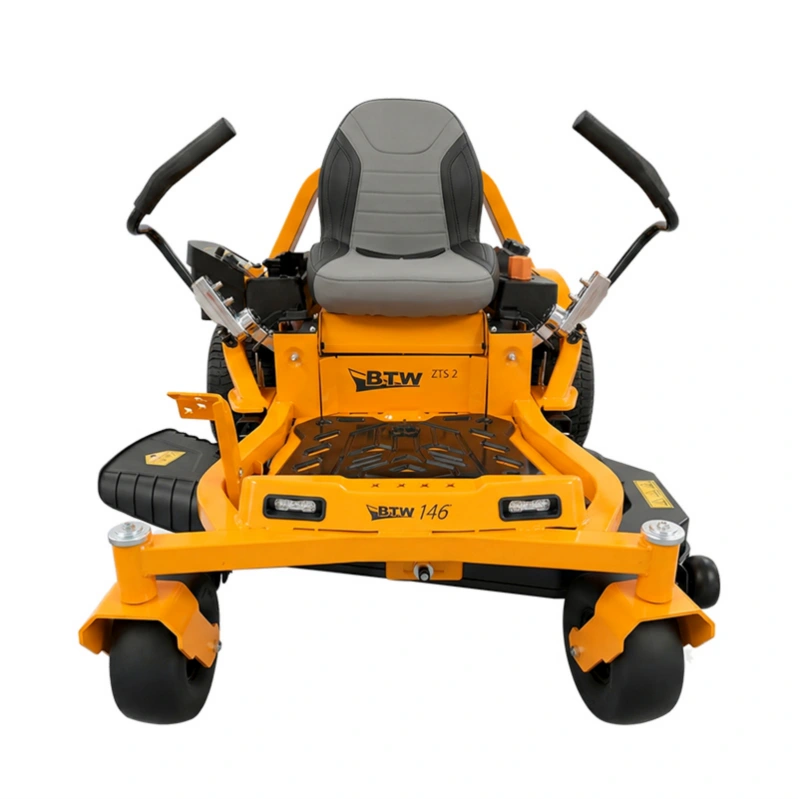
Zero-turn machines are designed for fast directional changes and tight turning. Their steering layout allows operators to maneuver around trees, poles, landscaping features, and buildings with fewer wide turns.
This makes them useful for commercial landscaping contractors and property maintenance teams working on relatively open ground with frequent obstacles.
A zero-turn riding lawn mower can also improve operator productivity when the mowing route contains many changes in direction.
However, zero-turn capability should not be treated as a universal solution. Buyers still need to evaluate slope limits, traction, ground conditions, operator training, and manufacturer recommendations.
Conventional Riding Lawn Mowers
Conventional riding mowers use a more familiar steering arrangement and can work well for residential properties, institutional grounds, small commercial sites, and mixed mowing conditions.
They may provide a practical balance between maneuverability, operator familiarity, and purchase cost.
For buyers who maintain properties with moderate grass areas and relatively simple layouts, a conventional riding mower can provide sufficient productivity without requiring the configuration of a specialized commercial machine.
Commercial Riding Lawn Mowers
A commercial riding lawn mower is designed around higher utilization and more demanding mowing schedules. The important difference is not only engine size.
Commercial buyers should examine the complete machine architecture. This includes frame construction, deck structure, transmission, cooling, steering controls, tires, seat design, service access, and safety systems.
The machine should also support a practical maintenance schedule. When a mower operates every day, small service difficulties can become significant labor costs over a full season.
Heavy-Duty Riding Mowers
A heavy-duty mower should be selected when operating conditions place greater demands on the machine.
Typical factors include:
- Large mowing areas
- Long daily operating hours
- Dense or fast-growing grass
- Uneven ground
- Frequent commercial use
- Higher transport requirements
- Demanding seasonal workloads
A heavy duty riding lawn mower can be a suitable option when durability and sustained operation matter more than minimum purchase price.
The buyer should still confirm the manufacturer’s operating limits. Heavy-duty construction does not remove terrain restrictions or eliminate the need for operator training.
How Should Businesses Compare Mower Specifications?
Specification sheets can contain many numbers, but not every number has equal importance. Commercial buyers should focus on specifications that affect productivity, operating cost, reliability, and service.
The following table provides a practical framework.
Table 1. Key riding lawn mower specifications for commercial purchasing
| Specification | Why It Matters | Questions for Buyers |
|---|---|---|
| Cutting width | Determines potential mowing productivity | Is the deck suitable for the property layout? |
| Engine output | Supports blade and drive performance | Does output match deck size and workload? |
| Fuel capacity | Affects operating time between refueling | Can the mower complete a normal work cycle? |
| Transmission | Influences drive performance and service needs | What is the transmission design and service procedure? |
| Turning capability | Affects maneuverability and mowing time | How easily can the mower work around obstacles? |
| Deck construction | Influences durability and maintenance | How is the deck built and serviced? |
| Tire configuration | Affects traction and ground contact | Are the tires suitable for the operating surface? |
| Seat and controls | Influence operator fatigue | Can operators work comfortably for long periods? |
| Service access | Affects maintenance labor | Can routine components be reached easily? |
| Safety systems | Reduce operating risks | Are required guards and operator controls installed? |
Match Deck Width to Property Layout
Deck width should reflect the shape of the mowing area.
For a large open field, a wide deck can reduce the number of passes. For a property with narrow entrances and dense landscaping, excessive width can create access problems.
Procurement teams should therefore measure the narrowest access points before selecting a machine. This simple step can prevent an expensive mismatch between the mower and the property.
Consider Ground Conditions
Ground conditions affect traction and stability. Wet grass can reduce traction and change braking behavior. Uneven surfaces can increase vibration and place additional stress on the chassis and deck.
Slope operation requires particular care. OSHA advises employers to consider manufacturer slope limits and terrain hazards when using riding mowers. OSHA also highlights rollover risks around slopes, drop-offs, embankments, ditches, and water.
The safest procurement decision begins with a site assessment rather than a catalog comparison.
Evaluate Maintenance Access
Maintenance affects the real cost of ownership. Operators and technicians need practical access to service points, belts, filters, blades, lubrication points, and other wear components.
A machine that takes less time to inspect and service can reduce downtime during busy mowing periods.
Buyers should ask suppliers for recommended service intervals and maintenance procedures before placing an order.
Is a Commercial Riding Lawn Mower Worth the Investment?
For businesses with high mowing utilization, a commercial machine can justify a higher initial investment through productivity and operating efficiency.
The correct comparison should not focus only on the purchase price. Buyers should calculate the total operating cost across the expected service period.
A useful calculation includes:
Purchase cost + fuel or energy cost + scheduled maintenance + replacement parts + labor downtime + transportation cost
This approach gives procurement teams a clearer picture of the machine’s economic performance.
Example: Landscaping Contractor
Consider a landscaping contractor responsible for multiple commercial properties. The company operates its mower five days per week during the main growing season.
A low-cost mower may reduce the initial investment. However, if the machine requires more frequent repairs or finishes each property more slowly, the apparent saving can disappear.
A commercial mower with higher productivity may produce better economics if it reduces operating hours across the same workload.
For example, assume a contractor needs to mow 40 acres per week. A machine with a more suitable cutting configuration and higher effective productivity may reduce total operating hours.
The benefit does not come from one specification. It comes from the interaction between deck width, operating speed, turning efficiency, reliability, and operator workflow.
Example: Municipal Grounds
Municipal buyers may have a different priority structure. Their equipment can operate across parks, public green spaces, roadside areas, and institutional properties.
The procurement decision may therefore emphasize:
- Long service life
- Operator safety
- Easy routine maintenance
- Replacement part availability
- Consistent mowing performance
- Suitable terrain capability
- Fleet standardization
For public-sector fleets, service support can be as important as the initial machine specification.
Example: Large Property Management
A property management company may maintain several large properties with different layouts.
In this case, purchasing one mower type for every site may not be the most efficient strategy.
An open commercial property may benefit from a zero-turn mower. A property with narrower access routes may require a different configuration. A site with demanding ground conditions may require a more robust chassis and drive system.
The best fleet can therefore contain more than one mower category.
How Should Buyers Evaluate a Riding Lawn Mower on Sale?
A riding lawn mower on sale can offer an attractive purchase opportunity, but price should not become the main selection criterion.
A discounted machine may have a configuration that does not match the intended workload. It may also include a smaller deck, lower engine output, limited accessories, or a specification designed for lighter use.
Commercial buyers should compare the complete configuration before approving a purchase.
Check the Full Specification
When comparing discounted machines, confirm:
- Engine model and output
- Cutting deck width
- Transmission configuration
- Fuel capacity
- Tire specification
- Frame construction
- Safety equipment
- Service intervals
- Warranty terms
- Spare parts availability
The same product name can also appear with different specifications in different markets. Procurement teams should therefore request a formal specification sheet before comparing quotations.
Compare Price Against Operating Hours
A machine that costs less but operates more slowly may increase labor expenses.
For example, if one mower saves $1,000 at purchase but requires significantly more operating hours each year, the initial saving may have limited value.
The better approach is to calculate cost per operating hour or cost per acre where reliable productivity data is available.
Check After-Sales Support
After-sales support becomes more important as utilization increases.
Ask the supplier about technical documentation, spare parts, maintenance guidance, warranty coverage, and communication procedures.
For commercial buyers, downtime can affect customer contracts and scheduled maintenance work. Supplier support should therefore form part of the purchasing evaluation.
What Safety Factors Should Buyers Consider?
Safety should remain part of the machine selection process, particularly for commercial operations with multiple operators.
OSHA identifies rollover hazards as a major concern for riding mower operators. It recommends appropriate safety equipment, operator training, terrain assessment, and compliance with manufacturer operating limits.
OSHA also states that riding mower operators should receive training before operating the equipment. Training should cover machine controls, terrain hazards, slope conditions, obstacles, safety systems, and operating procedures.
ROPS and Seat Belts
Where a mower is designed for a roll-over protective structure, buyers should verify the correct ROPS configuration and associated seat belt requirements.
OSHA specifically notes that a mower equipped with ROPS should also have an appropriate seat belt system.
Procurement teams should verify the configuration against the manufacturer’s documentation and applicable local requirements.
Operator Presence and Interlock Systems
Safety interlocks can help prevent unintended machine operation.
OSHA guidance identifies operator presence controls and interlocks among the safety features that should remain functional. These systems can help stop blade operation or prevent engine starting under unsafe conditions.
Buyers should include safety-system inspection in their acceptance process.
Terrain and Slope
Do not select a mower based only on its engine power when the site contains slopes.
Manufacturers specify operating limits for individual machines. Those limits should take priority over assumptions based on engine size or machine weight.
OSHA advises users to avoid operating riding mowers beyond manufacturer-specified slope limits. It also highlights additional risks near drop-offs, ditches, water, and embankments.
FAQ About Choosing the Best Riding Lawn Mower
What is the best riding lawn mower for commercial use?
The best riding lawn mower for commercial use depends on property size, terrain, mowing frequency, obstacles, and annual operating hours. For open properties, a zero-turn model may improve productivity. For demanding workloads, buyers may prefer a heavy-duty configuration with stronger service support.
Is a commercial riding lawn mower better than a residential mower?
A commercial riding lawn mower is generally designed for higher utilization and more demanding operating schedules. However, the best choice depends on actual workload. A commercial machine may not provide sufficient economic benefit for occasional mowing.
Is a zero-turn mower suitable for large properties?
Yes, zero-turn mowers can be effective on large properties with obstacles and relatively suitable terrain. Their turning capability can reduce maneuvering time around trees, buildings, and landscaping features.
What should I check before buying a riding lawn mower on sale?
Check the complete specification rather than the discount alone. Review engine output, deck width, transmission, frame construction, service requirements, safety systems, warranty terms, and spare parts availability.
Is a heavy duty riding lawn mower suitable for uneven ground?
A heavy-duty configuration may provide better durability for demanding conditions, but it does not automatically make a mower suitable for every slope or surface. Buyers should follow the manufacturer’s terrain and slope limits.
How do I compare two riding lawn mower suppliers?
Compare product specifications, production capability, quality control, documentation, warranty terms, spare parts support, technical communication, lead time, and customization capability. A reliable comparison should evaluate the supplier as well as the machine.
Does a larger cutting deck always mean higher productivity?
No. A larger deck can reduce mowing passes on open ground, but it may reduce maneuverability in narrow or obstacle-heavy areas. Effective productivity depends on deck width, operating speed, turning ability, terrain, and property layout.
What matters more, price or operating cost?
For commercial buyers, operating cost usually provides a more useful long-term comparison. Purchase price, fuel consumption, maintenance, labor hours, downtime, and replacement parts should all be considered.
How Can Buyers Select the Right Mower Configuration?
A practical purchasing process can follow five steps.
First, measure the total mowing area and identify the most demanding site.
Second, record terrain conditions, including slopes, wet areas, narrow access points, and obstacles.
Third, estimate annual operating hours and the expected workload during peak season.
Fourth, determine the required deck width, engine output, transmission, tires, and safety configuration.
Fifth, request comparable quotations from suppliers using the same specification requirements.
This process prevents price from becoming the only basis for comparison.
For fleet purchases, buyers can also classify machines by application.
| Application | Main Priority | Suitable Direction |
|---|---|---|
| Large open grounds | Productivity | Wide-deck riding mower |
| Commercial landscaping | Maneuverability and utilization | Commercial zero-turn mower |
| Uneven working conditions | Durability and stability | Heavy-duty configuration |
| Institutional grounds | Reliability and service | Commercial riding mower |
| Small commercial properties | Flexibility and cost | Compact riding mower |
| Multi-site operations | Fleet flexibility | Mixed mower configurations |
Table 2. Application-based riding lawn mower selection guide
This approach gives procurement teams a clearer technical basis for supplier discussions.
Why Supplier Selection Matters as Much as Machine Selection
The machine is only one part of the purchasing decision. Commercial buyers also depend on the supplier for documentation, replacement parts, technical information, warranty processing, and long-term communication.
A supplier should be able to explain the differences between available configurations without relying only on generic sales descriptions.
The supplier should also understand the customer’s working environment. A useful quotation should identify the recommended configuration and explain why it fits the application.
For overseas buyers, export experience can also affect the purchasing process. Documentation, packaging, shipping arrangements, spare parts, and communication can influence the total project cost.
Buyers should therefore compare suppliers using both technical and commercial criteria.
Product Fit
The supplier should confirm whether the mower matches the intended terrain, mowing area, and workload.
Serviceability
Routine maintenance should remain practical for the operator or local service team.
Spare Parts
Common wear parts should be available through a clear supply process.
Documentation
The supplier should provide operating instructions, technical specifications, maintenance information, and relevant product documentation.
Communication
Technical questions should receive specific answers rather than generic statements.
Final Buying Checklist
Before purchasing a riding lawn mower, commercial buyers can use the following checklist:
- Define the total mowing area.
- Measure narrow access points.
- Identify slopes and difficult terrain.
- Estimate annual operating hours.
- Determine the required cutting width.
- Match engine output to workload.
- Review transmission configuration.
- Check deck construction.
- Evaluate operator controls.
- Confirm safety systems.
- Review maintenance intervals.
- Check spare parts availability.
- Compare warranty terms.
- Calculate expected operating costs.
- Compare supplier support.
- Request a complete quotation.
This checklist helps buyers separate a suitable machine from a machine that only looks attractive on paper.
About Xinghu
Xinghu supplies riding lawn mower solutions for customers seeking practical equipment for residential, commercial, landscaping, and demanding mowing applications. The product range includes riding mower configurations designed around different working conditions, cutting requirements, and operating needs.
As a riding lawn mower supplier, Xinghu focuses on product configuration, technical specifications, production support, and communication with international buyers. Customers can discuss their mowing area, terrain, expected workload, and preferred configuration before selecting a suitable machine.
For buyers comparing a commercial riding lawn mower, a zero-turn model, or a heavy-duty riding lawn mower, the right starting point is the working condition rather than the advertised price. A mower that matches the application can improve productivity, simplify maintenance, and support more predictable operating costs over its service life.
References
- U.S. Occupational Safety and Health Administration, “Dangers of Roll-Overs of Riding Mowers.” OSHA Riding Mower Safety Guidance
- U.S. Environmental Protection Agency, “Regulations for Emissions from Small Equipment & Tools.” U.S. EPA Small Equipment and Tools Regulations
- U.S. Environmental Protection Agency, “Engine Testing Regulations.” U.S. EPA Engine Testing Regulations
- U.S. Occupational Safety and Health Administration, “Guarding of Portable Powered Tools.” OSHA Machine Guarding Requirements