

What Is CFM in a Leaf Blower and How Does It Dictate Commercial Equipment Performance?
October 21, 2026
Cubic feet per minute, abbreviated as CFM, measures the total volume of air a blower pushes out through its nozzle in sixty seconds. Equipment buyers must evaluate CFM to determine how much debris an engine can move across large surface areas. For example, a landscaping crew clearing wet autumn leaves off a three-acre commercial parking lot requires a unit producing at least eight hundred CFM to clear heavy piles efficiently. Conversely, an operator using a small hand-held unit rated at three hundred CFM will spend twice as much time moving the same volume of wet organic material. Understanding air volume metrics allows commercial fleet managers to select equipment that maximizes labor efficiency and reduces operational costs.
Decoding Airflow Dynamics: The Relationship Between CFM and MPH
Air volume and air speed work together to create effective blowing force on ground surfaces. While CFM measures total air quantity, miles per hour, or MPH, measures the velocity of the air exiting the nozzle. A blower needs sufficient air velocity to dislodge stubborn debris stuck to asphalt or turf. Once the air stream breaks the initial debris adhesion, air volume takes over to push the pile forward.
Engineers calculate blowing force by multiplying air volume by air velocity using specific fluid dynamic equations. High air speed without adequate air volume creates a narrow jet that scatters small pebbles without moving broad leaf piles. High air volume with low velocity creates a soft breeze that fails to lift damp debris from saturated soil.
Commercial applications require balancing these two metrics according to specific job site requirements. A operator clearing dry grass clippings off a flat concrete sidewalk needs high velocity to work quickly. A worker clearing heavy pine needles, wet twigs, or packed snow off uneven ground relies heavily on high air volume to move dense mass.
| Airflow Metric | Physical Unit Measured | Primary Operational Impact | Ideal Commercial Application |
| CFM (Cubic Feet per Minute) | Air Volume Flow Rate | Dictates total debris pile moving capacity | Large lawn clearing, wet leaf removal |
| MPH (Miles per Hour) | Air Exit Velocity | Breaks initial debris adhesion to surfaces | Hardscape cleaning, crevice sweeping |
| Blowing Force (Newton) | Combined Kinetic Vector | Measures total work capacity delivered to ground | Commercial site cleanup, heavy snow removal |
Table 1: Comparison of fluid dynamic metrics and their practical impacts on commercial maintenance tasks.
Selecting equipment based purely on peak numbers printed on product packaging often leads to inaccurate performance expectations. Commercial buyers should verify whether manufacturers measure air volume at the pipe exit or inside the housing chamber. Standardized laboratory testing methods measure air parameters at the tip of the nozzle to reflect real-world operating conditions.
Evaluating CFM Requirements Across Commercial Maintenance Applications
Matching equipment specifications to property size prevents equipment overspending and operator fatigue. Residential landscaping tasks require lower air volume compared to continuous municipal or commercial property maintenance. Facility managers must evaluate typical debris composition, surface topography, and daily operating hours before issuing procurement orders.
Small courtyard spaces, paved walkways, and light maintenance zones operate effectively with compact equipment configurations. Operators handling daily maintenance in tight spaces benefit from using a lightweight leaf blower to minimize shoulder strain during extended shifts. Units in this category deliver three hundred to five hundred CFM, providing sufficient force for dry material management.
Municipal parks, golf courses, and expansive commercial campuses require substantially higher air volume outputs. Operating a commercial leaf blower rated above seven hundred CFM enables crews to move large mounds of wet leaves, pine cones, and small branches across wide turf areas. High air volume sweeps a wider path with each pass, reducing total walking distance for workers.
Cold weather maintenance environments demand maximum air displacement to handle heavy winter conditions. Utilizing a dual-purpose snow and leaf blower allows facilities to clear light powdery snow off sidewalks and stadium seating without deploying heavy mechanical plows. The high-volume air stream prevents snow from compacting into ice under foot traffic.
Landscape contractors managing high-volume fall cleanup contracts often deploy multi-stage equipment strategies. Crew members use handheld units to blow debris out from under bushes and building foundations into open lawn channels. Main line operators then use high-capacity units to sweep the accumulated debris windrows into collection trucks.
Structural Engine Types and Their CFM Capabilities
Engine displacement and power system architecture directly constrain the maximum air volume a machine can generate. Two-stroke gasoline engines deliver high power-to-weight ratios, making them popular for commercial backpack configurations. Four-stroke engines offer cleaner emissions and quieter operation but add overall weight to the power head assembly.
Electric battery-powered units continue to advance in air displacement performance due to brushless motor technology. High-voltage lithium-ion battery packs drive axial fans capable of producing over six hundred CFM in short burst modes. Battery run-time limits make these units ideal for noise-sensitive zones like hospitals, school districts, and residential neighborhoods.
| Equipment Configuration | Typical Engine / Power Source | Average CFM Output Range | Average Weight Range (kg) | Recommended Duty Cycle |
| Handheld Cordless / Gas | 25cc – 30cc or 36V Battery | 350 – 550 CFM | 3.5 – 5.5 kg | Intermittent / Light Duty |
| Commercial Backpack | 50cc – 80cc 2-Stroke Gas | 700 – 1000+ CFM | 8.5 – 12.5 kg | Continuous / Heavy Commercial |
| Walk-Behind Wheeled | 150cc – 300cc 4-Stroke Gas | 1200 – 2200+ CFM | 35.0 – 65.0 kg | Heavy Industrial / Large Turf |
Table 2: Engine types, physical weight parameters, and corresponding airflow output capabilities.
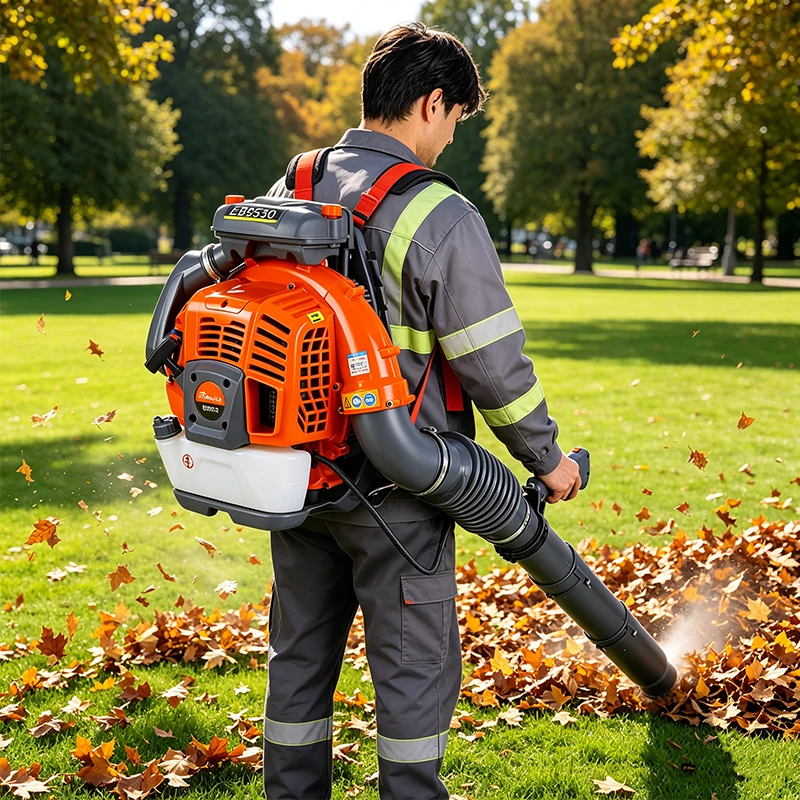
Backpack equipment layouts distribute power plant weight across the operator’s hips and shoulders using padded harness systems. Carrying an 80cc engine on the back allows manufacturers to install larger impeller fan housings. Larger impellers draw greater air volumes through the intake vents, generating the high CFM numbers required for commercial clearing operations.
Walk-behind wheeled units utilize massive four-stroke engines to turn heavy steel impellers inside reinforced scroll housings. These units generate over fifteen hundred CFM, creating massive air curtains capable of clearing entire parking lots in minutes. Facility managers deploy wheeled units for flat asphalt surfaces where operator pushing force replaces shoulder-borne equipment loads.
Handheld equipment designs require strict weight limitations to preserve operator comfort and ergonomics during daily operation. A portable leaf blower balances fan housing dimensions against total engine weight. Engine designers optimize internal air channels to maximize velocity when overall volume is constrained by compact housing dimensions.
Ergonomic Design Factors and Operating Efficiency
High CFM outputs create equal and opposite reactive forces that push back against the operator’s arm or body. Newton’s third law of motion dictates that pushing massive volumes of air forward creates backward thrust. Equipment manufacturers design ergonomic handles, waist belts, and spring-damped anti-vibration mounts to absorb these reactive forces during long work shifts.
Backpack harness design plays a crucial role in maintaining operator stamina when operating high-output equipment. Commercial harness assemblies feature adjustable chest straps, thick lumbar support pads, and breathable mesh back liners. Distributing machine weight evenly across the torso prevents lower back fatigue during eight-hour commercial cleanup cycles.
Throttle control systems on professional equipment include cruise control levers to lock in desired engine speeds. Locking the throttle eliminates constant trigger squeezing, reducing hand fatigue and repetitive strain injuries. Variable speed triggers allow operators to lower air volume instantly when working near delicate flower beds or glass windows.
Noise regulation compliance requires careful engineering of intake vents and fan blade geometries. High CFM machines draw vast quantities of air per second, creating high-frequency sound waves as fan blades slice through air currents. Acoustic baffles and pitched fan blade designs lower decibel ratings without restricting total air volume throughput.
Are you looking to expand your commercial equipment inventory with reliable, high-performance landscaping machinery? Contact Xinghu sales engineers today to discuss bulk wholesale options and detailed technical specifications.
Flexible tube joints manufactured from cold-resistant rubber allow full range of motion for the blower nozzle. Operators sweep the air nozzle in a wide arc using simple wrist movements. Smooth internal pipe walls minimize turbulent air friction, preserving total CFM delivered to the exit tip.
Weight distribution across the engine frame prevents top-heavy tipping when setting equipment on ground surfaces. Sturdy tubular steel frame bases protect plastic fuel tanks and engine housings from damage during transport in open utility trailers. Durable frame construction ensures equipment survives rough handling on commercial job sites.
Strategic Procurement Criteria for Commercial Equipment Buyers
Procurement officers managing commercial fleets must analyze equipment specifications beyond initial purchase prices. Total cost of ownership calculations include fuel efficiency, spare parts availability, maintenance simplicity, and equipment service life. Investing in durable commercial machinery lowers long-term operational expenses across multi-year municipal contracts.
Impeller design and material selection determine long-term resistance to mechanical wear. Ingesting gravel, small stones, and hardwood twigs can crack cheap plastic fan blades operating at seven thousand revolutions per minute. Commercial units utilize impact-resistant polymer alloys or cast aluminum impellers to withstand debris impacts without shattering.
Air filtration systems protect internal engine cylinders from fine dust generated during dry clearing operations. Dual-stage air filters combine foam pre-filters with pleated paper elements to capture microscopic dirt particles. Clean intake air prevents piston ring abrasion, maintaining high engine compression and consistent CFM output over years of daily service.
| Component Evaluation | Low-Cost Commercial Grade | Heavy-Duty Professional Grade | Operational Impact on Fleet |
| Air Filtration System | Single-stage foam pad | Dual-stage pleated paper + foam | Prevents premature engine cylinder wear |
| Impeller Material | Standard ABS plastic | Reinforced poly-resin / Aluminum | Resists cracking from gravel impacts |
| Harness Construction | Basic nylon webbing | Ergonomic padded hip-belt frame | Reduces worker fatigue and injury claims |
| Fuel Tank Capacity | 1.0 to 1.5 Liters | 2.0 to 2.8 Liters | Extends continuous run time per fill |
Table 3: Key hardware differences between standard commercial models and heavy-duty professional units.
Deploying a high powered backpack leaf blower across commercial property portfolios maximizes crew productivity. High-volume air displacement allows one operator to complete work that previously required two workers with underpowered units. Lowering labor hours per job site directly increases profitability for landscape maintenance contractors.
Specifying a heavy duty leaf blower with standardized service parts streamlines fleet maintenance schedules. Standardizing engine platforms allows mechanics to keep common spark plugs, air filters, starter ropes, and fuel lines in shop inventory. Simple maintenance procedures keep equipment working in the field rather than sitting in repair bays.
Fuel tank capacity influences daily crew efficiency by determining continuous operating times between fill-ups. Commercial units feature large fuel reservoirs constructed from translucent high-density polyethylene. Translucent tanks allow operators to check fuel levels instantly without removing gas caps in dusty field environments.
Vibration damping systems isolate engine oscillations from the operator frame using steel coil springs or heavy rubber bushings. Reducing vibration transfer to the user’s back and hands prevents long-term occupational health issues like white finger disease. Comfortable equipment improves worker satisfaction and reduces employee turnover rates.
Frequently Asked Questions
Is higher CFM or higher MPH more important for commercial leaf blowers?
Both metrics serve distinct functions, but high CFM is generally more important for commercial clearing operations. CFM determines total volume and pile-moving capability, while MPH provides the velocity required to break initial debris adhesion. For large commercial jobs, high CFM allows crews to clear broader paths in less time.
How does nozzle shape affect overall CFM and MPH performance?
A wide round nozzle maximizes CFM by allowing unrestricted air volume flow, making it ideal for moving large leaf piles. A narrow flat nozzle restricts air volume slightly to increase MPH velocity, creating a concentrated air stream that lifts wet or stuck debris off hard surfaces.
What is the ideal CFM rating for a commercial landscape contractor?
Commercial contractors should look for units delivering between 700 CFM and 1,000 CFM at the pipe tip. This performance level provides sufficient air volume to handle heavy wet leaves, packed pine needles, and light snow across large commercial properties efficiently.
How do battery-powered commercial blowers compare to gas models in CFM?
Modern commercial battery blowers can match gas models in peak CFM output, often reaching 600 to 800 CFM in turbo modes. However, gas blowers maintain continuous high CFM output for longer durations without requiring battery swaps or cooling breaks during heavy commercial shifts.
Why do manufacturers measure CFM both at the housing and at the pipe tip?
Housing CFM measures the air volume exiting the fan impeller before entering the discharge tube, which yields higher numbers for marketing purposes. Pipe tip CFM measures actual air volume exiting the nozzle end, providing the accurate performance metric that commercial buyers need for operational planning.
Powering Commercial Maintenance Fleet Success with Xinghu
Xinghu manufactures professional outdoor power equipment designed for commercial landscaping contractors, municipal public works departments, and global equipment distributors. Our product portfolio includes high-output backpack blowers, commercial snow clearing machinery, and durable engine platforms built for rigorous daily duty. Every Xinghu machine incorporates precision-machined internal components, ergonomic harness architectures, and fuel-efficient power plants engineered to maximize job site productivity. We back our wholesale partners with complete spare parts availability, flexible OEM manufacturing options, and dedicated technical support to help you grow your regional market share.
References
- ANSI B175.2-2012 Outdoor Power Equipment – Hand-Held and Backpack Power Blowers – Safety Requirements and Performance Testing, American National Standards Institute, https://www.ansi.org/
- Outdoor Power Equipment Institute (OPEI) Equipment Guidelines and Safety Standards, Outdoor Power Equipment Institute, https://www.opei.org/